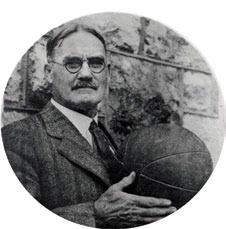
The history of basketball began with its invention in 1891 in Springfield, Massachusetts by Canadian physical education instructor James Naismith as a less injury-prone sport than football. The game became established fairly quickly and grew very popular as the 20th century progressed, first in America and then throughout the world. After basketball became established in American colleges, the professional game followed. The American National Basketball Association (NBA), established in 1949, grew to a multibillion-dollar enterprise by the end of the century, and basketball became an integral part of American culture
Invention of the game
The game of basketball as we know it today was created by Dr. James Naismith in December 1891 in Springfield, Massachusetts to condition young athletes during cold months. It consisted of peach baskets and a soccer style ball. He published 13 rules for the new game. He divided his class of 18 into two teams of nine players each and set about to teach them the basics of his new game. The objective of the game was to throw the basketball into the fruit baskets nailed to the lower railing of the gym balcony. Every time a point was scored, the game was halted so the janitor could bring out a ladder and retrieve the ball. After a while, the bottoms of the fruit baskets were removed. The first public basketball game was played in Springfield, Massachusetts, on March 11, 1892.
Professional leagues, teams, and organizations
The first professional league was founded in 1898. Six teams took part in the National Basketball League, and the first champions were the Trenton Nationals, followed by the New York Wanderers, the Bristol Pile Drivers and the Camden Electrics. The league was abandoned in 1904.[13] Then, many small championships were organized, but most of them were not as important as some teams who played for money against challengers.
The Original Celtics, for instance, are considered the "fathers of basketball"[14] and were presented as "World’s Basketball Champions";[14] the players had to sign a contract to play with them, and Jim Furey organized matches as a circus, moving daily from town to town. The Celtics became the strongest team, and their successes lasted from 1922 until 1928, when the team disbanded due to ownership problems. The Original Celtics are sometimes incorrectly thought of as forebears of the current Boston Celtics of the NBA; in reality, they share only a name, as today's Celtics were not founded until 1946, nearly two decades after the demise of the Original Celtics. In 1922, the first all-African American professional team was founded: the Rens (also known as New York Renaissance or Harlem Renaissance).[15] The Rens were the Original Celtics’ usual opponent, and for their matches a ticket cost $1.[16] They took part in some official championships and won the first World Professional Basketball Tournament in 1939. The team disbanded in 1949.
Use this resource to learn Basketball Rules, Terminology and Definitions categorized in alphabetical order.
If you are looking for a term that’s not here, contact us and let us know.
I also need to recommend Coach Turner’s Hoops Terms Compendium where you will find nearly 500 terms and definitions — from the ‘normal’ basketball terms to the slang expressions! Coach Turner has put together a fantastic resource!
Alternating-possession rule:The possession arrow changes direction after each held ball situation, alternating which team gets possession of the ball.
Assist:
A pass that immediately precedes and sets up a scored basket.
Backboard:The rectangular or fan-shaped board behind the basket.
Backcourt:
The half of the court that is opposite a team’s offensive basket; the court a team is attempting to defend.
Ball handler:
The player with the ball; usually the point guard at the start of a play.
Ball Side:
The half of the court from the middle to the sideline where the ball is currently located. May also be referred to as the ‘strong side’.
Bank shot:
A shot where the ball is first bounced (or banked) off the backboard at such an angle that it then drops into the basket.
Baseline:
The boundary line behind each basket; also called the endline.
Basket:Attached to the backboard, it consists of a metal rim 18″ in diameter suspended 10′ from the floor, from which a 15-18″ corded net hangs, and through which points are scored; also used to refer to a successful field goal.
Beat the defender:
When an offensive player, with or without the ball, is able to get past an opponent who is guarding him.
Bench Points:
The number of points scored during a game from players that began the game on the bench. All points scored by non-starters.
Blocked shot:
The successful deflection of a shot by touching part of the ball on its way to the basket, thereby preventing a field goal.
Blocking:
The use of a defender’s body position to illegally prevent an opponent’s advance; the opposite of charging.
Bonus free throw:
See “One-and-One.”
Bounce pass:
A pass that strikes the floor before it reaches the receiver.
Boxing out:
A player’s attempt to position his body between his opponent and the basket to get rebounds and prevent the opponents from doing so. Also referred to as Blocking out.
Carrying the ball:Also called “palming;” a violation committed by a dribbler that involves placing the dribbling hand under the ball and momentarily holding or carrying it while dribbling.
Center:
Also called the “pivot player;” an offensive position typically played by a tall player who plays mainly in the key areas (at the post).
Center court circle:
The circular area at midcourt from which jump balls are taken.
Charging:
A personal foul committed when an offensive player illegally contacts a defensive player who has established position or is stationary.
Chest pass:
A two-handed pass thrown from the passer’s chest in a straight line to the chest area of the receiver.
Controlling the boards:
Securing a majority of the rebounds.
Conversion:
A made basket or free throw.
Court vision:
A player’s ability to see everything on the court during play — such as where his teammates and defenders are set up — which enables him to make better choices in passing; the best players possess this trait.
Crossover dribble:
A dribble in which the ball is moved from one hand to the other while the dribbler changes directions.
Cut:
A quick movement by an offensive player to elude an opponent or to receive the ball.
Cylinder:
The imaginary area directly above the basket where goaltending or basket interference can occur.
Dead ball:Occurs whenever the whistle blows to stop play and after a field goal, but before the opponent gains possession of the ball.
Defense:
The team not in possession of the ball whose objective is to keep the opponent from scoring; also a specific pattern of play used by a defending team.
Defensive rebound:
A rebound of an opponent’s missed shot.
Double-double:
When a player scores double-digits in 2 categories during one game (points, assists and rebounds are most common, but it can also be blocks or steals); a sign of great versatility.
Double dribble:
A violation that occurs when a player dribbles the ball with two hands simultaneously or stops dribbling and then dribbles again.
Double foul:
A situation in which two opponents commit a foul against each other simultaneously.
Double team:
A defensive tactic in which two defenders temporarily guard one player.
Downcourt or down the court:
The direction a team on offense moves, from its backcourt into its frontcourt and towards its own basket.
Dribble or dribbling:
Process by which a player repeatedly bounces the ball off the floor so that it returns to his/her possession. It’s the only legal means by which a single player may move the ball across the court.
Drive:
A quick dribble directly to the basket in an effort to score.
Dunk:
When a player close to the basket jumps and strongly throws the ball down into it; an athletic, creative shot used to intimidate opponents.
Elbow:A term often used to indicate the area of the court where the free-throw line and side of the key meet.
Elbowing:
It is a violation if a player vigorously or excessively swings his elbows, even if there is no contact; it is a foul if contact is made.
End line:
See ‘baseline’.
Established position:
When a defensive player has both feet firmly planted on the floor before an offensive player’s head and shoulder get past him; the offensive player who runs into such a defender is charging.
4-point play:A made 3-point field goal in which the shooter was fouled, followed by a successful free-throw.
Fake or feint:
A deceptive move to throw a defender off balance and allow an offensive player to shoot or receive a pass; players use their eyes, head or any other part of the body to trick an opponent.
Fastbreak:
An offensive strategy in which a team attempts to move the ball downcourt and into scoring position as quickly as possible so that the defense is outnumbered and does not have time to set up.
Field goal:
A basket scored on any shot other than a free throw, worth two or three points depending on the distance of the attempt from the basket.
Flagrant foul:
Unnecessary or excessive contact against an opponent.
Forward:
An offensive position played to the sides of the basket near the key area and out toward the sideline along the baseline.
Foul (also referred to as ‘personal foul’):
A violation resulting from illegal contact with an opposing player.
Foul line:
See “Free-throw line.”
Foul shot:
See “Free-throw.”
Free throw:
An unguarded shot taken from behind the free-throw line after a foul. If successful, the shot counts one point.
Free-throw lane:
Also called the “key” or “lane;” a 12-foot wide area extending from the baseline to the free-throw line. Players may not be in this area during a free-throw attempt.
Free-throw line:
A 12-foot-long line that is parallel to and 15 feet from the backboard.
Free-throw line extended:
An imaginary line drawn from the free-throw line to the sideline to determine the location for certain plays.
Front court:
The half of the court (divided by the center line) that contains the offensive team’s basket; the offensive half of the court.
Full–court press:
A defensive tactic in which a team guards the opponents closely the full length of the court.
Game clock:Shows how much time remains in each quarters or halves of games.
Guard:
An offensive position played primarily at the perimeter, or away from the basket.
Guarding:
The act of following an opponent around the court to prevent him from getting close to the basket, taking an open shot or making easy an pass, while avoiding illegal contact.
Half-court or set offense:When a team takes the time to develop a play in its frontcourt, such as the give-and-go or a screening play; opposite of fast break.
Held ball:Formerly called a “jump ball.” When two players on opposite teams are in joint control of the ball.
Help Side:
The half of the court from the middle to the sideline opposite to where the ball is currently located.
Hesitation Dribble:
A dribbling action with a change-of-pace intended to confuse and/or freeze the defender. The basic action is a stutter step in which the dribbler momentarily slows his or her pace and speed.
High percentage shot:
A shot that is likely to go in the basket, such as a layup.
High post:
An imaginary area outside either side of the foul lane at the elbow / free-throw line extended area.
Inbounds:The area within the baselines and sidelines of the court; also the act of bringing the ball into this area by means of a throw-in.
Incidental contact:
Minor contact usually overlooked by officials.
Inside shooting:
Shots taken by a player near or under the basket.
Intentional foul:
A personal foul that the official judges to be premeditated.
In the paint:
In the “key” area, so named because this area of the floor is painted.
Jump ball:The procedure for starting play at the beginning of a game or an overtime period. The official tosses the ball into the air between the two opponents positioned at the center-court circle; the two players jump up and try to tap the ball to a teammate.
Jump shot:
A shot that is released after the shooter has jumped into the air.
Jump stop:
A method used to come to a complete stop. Both feet must land simultaneously – either parallel or staggered – in order for it to be a jump stop.
Key:Also called the “free-throw lane” or “lane;” the area measuring 12 feet in width and extending from the free-throw line to the end line.
Layup or layin:A shot taken close to the basket that is usually banked off the backboard towards the basket.
Loose ball:
A ball that is alive but not in the possession of either team.
Low post:
An imaginary area outside either side of the foul lane close to the basket.
Lower percentage shot:
A shot that is less likely to go in the basket, such as one thrown by a player who is off balance or outside his shooting range.
Man-to-man defense:
A team defense in which each player is assigned to guard a particular opponent.
Offense:
The team that has possession of the basketball. Also, a structured pattern of play that a team uses while attempting to score.
Offensive rebound:
A rebound of a team’s own missed shot.
Officials:
The referees who control the game, stop and start play, and impose penalties for violations and fouls.
One-and-one:
The “bonus” free-throw situation awarded for non-shooting fouls after the opposing team exceeds a certain number of team fouls in a half. The person fouled shoots one free throw; if successful, the shooter takes a second shot.
Out of bounds:
The area outside of and including the end lines and sidelines.
Outside shooting:
Shots taken from the perimeter.
Over-and-back violation:
A violation that occurs when the offensive team returns the ball into the backcourt once it has positioned itself in the front court.
Overhead pass:
A two-handed pass thrown from above the forehead.
Overtime:
An extra period played to break a tie score at the end of a regulation game.
Palming:
See “Carrying the ball.”
Pass:
An intentional throw to a teammate.
Passer:
The player who passes the ball to a teammate.
Period:
Any quarter, half or overtime segment.
Perimeter:
The area beyond the foul circle away from the basket, including 3-point line, from which players take long-range shots.
Personal foul:
Contact between players that may result in injury or provide one team with an unfair advantage; players may not push, hold, trip, hack, elbow, restrain or charge into an opponent; these are also counted as team fouls.
Pick:
See “Screen or Screener”
Pick and Roll:
A play in which an offensive player sets a pick for the dribbler, then cuts off that pick, or ‘rolls’, toward the basket looking for a pass from the dribbler for a shot.
Pick-up games:
Impromptu games played among players who just met.
Pivot:
A footwork technique in which a player keeps one foot in contact with a “spot” on the floor while moving the other foot to adjust the position of the body or to evade a defensive player.
Point guard:
An offensive position played by a guard who usually brings the ball up the court and initiates the offense.
Possession:
To be holding or in control of the ball.
Possession arrow:
Used to determine which team’s turn it is to inbounds the ball to begin a period or in a held ball situation.
Post:
An offensive position played close to the basket along the key.
Press:
An aggressive defense that attempts to force the opponents to make errors by guarding them closely from either half court, three-quarter court or full court.
Quadruple double:
A triple double with double-digits scored in 4 categories.
Rebound:
The act of gaining possession of the ball after a missed shot.
Run:
Occurs when one team scores several field goals in quick succession while its opponents score few or none.
Scoring opportunity:
When a player gets open for a shot that is likely to score.
Screen or screener:
The offensive player who stands between a teammate and a defender to gives his teammate the chance to take an open shot.
Scrimmage:
An unofficial game between two teams, or five-on-five play between team members in a practice situation.
Shot clock:
A clock that limits the time a team with the ball has to shoot it; 24 seconds in the NBA; in college, 35 seconds for men, 30 seconds for women.
Shooter:
A player who takes a shot at the basket.
Shooter’s roll or shooter’s touch:
The ability to get even an inaccurate shot to bounce lightly off the rim and into the basket.
Shooting range:
The distance from which a player is likely to make his shots.
Sidelines:
2 boundary lines that run the length of the court.
Sixth man:
The best substitute on a team; usually the first player to come off the bench to replace a starter.
Slam dunk:
See “dunk.”
Squaring up:
When a player’s shoulders are facing the basket as he releases the ball for a shot; considered good shooting position.
Substitute:
A player who comes into the game to replace a player on the court.
Swing man:
A player who can play both the guard and forward positions.
3-point play:
A made 2-point field goal in which the shooter was fouled, followed by a successful free-throw.
3 seconds:
A violation in which an offensive player remains within the key for more than three seconds at a time.
Team fouls:
Each personal foul committed by a player is also counted against his team; when a team goes over the limit, its opponent is awarded free-throw opportunities.
Technical foul:
A foul that does not involve contact with an opponent; a foul that involves unsportsmanlike conduct by a player, coach or non-player; or a contact foul committed by a player while the ball is dead.
Ten-second line:
The mid-court line over which the offensive team must advance the ball from the backcourt within 10 seconds to avoid a violation.
Three-point field goal:
A made basket from a distance greater than 19 feet and nine inches during a high school or college game.
Three-on-two:
A common fastbreak situation in which three offensive players attempt to score on two defenders.
Timeout:
When play is temporarily suspended by an official or at the request of a team to respond to an injured player or discuss strategy.
Transition:
The shift from offense to defense, and vice versa.
Traveling:
A violation occurring when a player with the ball takes a step without dribbling (moving the established pivot foot).
Triple double:
When a player scores double-digits in 3 categories during one game (points, assists and rebounds are most common, but it can also be blocks or steals); a sign of great versatility.
Triple Threat Position:
Triple threat is an offensive position a player can use who has not dribbled yet. The offensive player stands with knees flexed, feet slightly wider than shoulder width, and both hands on the basketball. From this position, the offensive player can either shoot, dribble, or pass to a teammate … thereby being a ‘triple threat’ with the basketball.
Turnover:
A loss of possession of the ball by means of an error or violation.
Upset:
When a higher-seeded (better) team loses to a lower-seeded (inferior) one.
Violation:
An infringement of the rules that’s not a foul. The penalty for a violation is the awarding of the ball to the opponent.
Weakside:
The side of the court away from the ball.
Zone defense:
A team defense in which each player is responsible for defending an area of the court and the opponents within that area.
Zone offense:
An offensive pattern of play designed to attack (score against) a particular zone defense.
Direction : Choose the correct answer.
1. Basketball was invented by a physical education instructor from:
2. The game was invented in the:
3. At first, players threw the ball into a:
4. The National Basketball Association (NBA) was set up in the:
5. The semi-circle at each end of the court is the:
6. The basket's rim must be at a height of:
7. Michael Jordan played most of his basketball for the:
8. One of the tallest NBA players is Yao Ming who was born in:
9. A goal scored by shooting from inside the 3-point line earns:
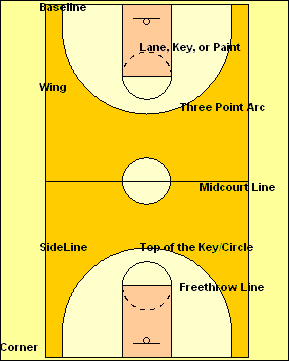
Basketball is a team sport. Two teams of five players each try to score by shooting a ball through a hoop elevated 10 feet above the ground. The game is played on a rectangular floor called the court, and there is a hoop at each end. The court is divided into two main sections by the mid-court line. If the offensive team puts the ball into play behind the mid-court line, it has ten seconds to get the ball over the mid-court line. If it doesn't, then the defense gets the ball. Once the offensive team gets the ball over the mid-court line, it can no longer have possession of the ball in the area in back of the line. If it does, the defense is awarded the ball.
Basketball Court 1
The ball is moved down the court toward the basket by passing or dribbling. The team with the ball is called the offense. The team without the ball is called the defense. They try to steal the ball, contest shots, steal and deflect passes, and garner rebounds.
When a team makes a basket, they score two points and the ball goes to the other team. If a basket, or field goal, is made outside of the three-point arc, then that basket is worth three points. A free throw is worth one point. Free throws are awarded to a team according to some formats involving the number of fouls committed in a half and/or the type of foul committed. Fouling a shooter always results in two or three free throws being awarded the shooter, depending upon where he was when he shot. If he was beyond the three-point line, then he gets three shots. Other types of fouls do not result in free throws being awarded until a certain number have accumulated during a half. Once that number is reached, then the player who was fouled is awarded a '1-and-1' opportunity. If he makes his first free throw, he gets to attempt a second. If he misses the first shot, the ball is live on the rebound.
Each game is divided into sections. All levels have two halves. In college, each half is twenty minutes long. In high school and below, the halves are divided into eight (and sometimes, six) minute quarters. In the pros, quarters are twelve minutes long. There is a gap of several minutes between halves. Gaps between quarters are relatively short. If the score is tied at the end of regulation, then overtime periods of various lengths are played until a winner emerges.
Each team is assigned a basket or goal to defend. This means that the other basket is their scoring basket. At halftime, the teams switch goals. The game begins with one player from either team at center court. A referee will toss the ball up between the two. The player that gets his hands on the ball will tip it to a teammate. This is called a tip-off. In addition to stealing the ball from an opposing player, there are other ways for a team to get the ball.
One such way is if the other team commits a foul or violation.
Personal fouls: Personal fouls include any type of illegal physical contact.
Hitting
Pushing
Slapping
Holding
Illegal pick/screen -- when an offensive player is moving. When an offensive player sticks out a limb and makes physical contact with a defender in an attempt to block the path of the defender.
Personal foul penalties: If a player is shooting while a being fouled, then he gets two free throws if his shot doesn't go in, but only one free throw if his shot does go in.
Three free throws are awarded if the player is fouled while shooting for a three-point goal and they miss their shot. If a player is fouled while shooting a three-point shot and makes it anyway, he is awarded one free throw. Thus, he could score four points on the play.
Inbounds. If fouled while not shooting, the ball is given to the team the foul was committed upon. They get the ball at the nearest side or baseline, out of bounds, and have 5 seconds to pass the ball onto the court.
One & one. If the team committing the foul has seven or more fouls in the game, then the player who was fouled is awarded one free throw. If he makes his first shot, then he is awarded another free throw.
Ten or more fouls. If the team committing the foul has ten or more fouls, then the fouled player receives two free throws.
Charging. An offensive foul that is committed when a player pushes or runs over a defensive player. The ball is given to the team that the foul was committed upon.
Blocking. Blocking is illegal personal contact resulting from a defender not establishing position in time to prevent an opponent's drive to the basket.
Flagrant foul. Violent contact with an opponent. This includes hitting, kicking, and punching. This type of foul results in free throws plus the offense retaining possession of the ball after the free throws.
Intentional foul. When a player makes physical contact with another player with no reasonable effort to steal the ball. It is a judgment call for the officials.
Technical foul. Technical foul. A player or a coach can commit this type of foul. It does not involve player contact or the ball but is instead about the 'manners' of the game. Foul language, obscenity, obscene gestures, and even arguing can be considered a technical foul, as can technical details regarding filling in the scorebook improperly or dunking during warm-ups.
VIOLATIONS
Walking/Traveling. Taking more than 'a step and a half' without dribbling the ball is traveling. Moving your pivot foot once you've stopped dribbling is traveling.
Carrying/palming. When a player dribbles the ball with his hand too far to the side of or, sometimes, even under the ball.
Double Dribble. Dribbling the ball with both hands on the ball at the same time or picking up the dribble and then dribbling again is a double dribble.
Held ball. Occasionally, two or more opposing players will gain possession of the ball at the same time. In order to avoid a prolonged and/or violent tussle, the referee stops the action and awards the ball to one team or the other on a rotating basis.
Goaltending. If a defensive player interferes with a shot while it's on the way down toward the basket, while it's on the way up toward the basket after having touched the backboard, or while it's in the cylinder above the rim, it's goaltending and the shot counts. If committed by an offensive player, it's a violation and the ball is awarded to the opposing team for a throw-in.
Backcourt violation. Once the offense has brought the ball across the mid-court line, they cannot go back across the line during possession. If they do, the ball is awarded to the other team to pass inbounds.
Time restrictions. A player passing the ball inbounds has five seconds to pass the ball. If he does not, then the ball is awarded to the other team. Other time restrictions include the rule that a player cannot have the ball for more than five seconds when being closely guarded and, in some states and levels, shot-clock restrictions requiring a team to attempt a shot within a given time frame.
Player Positions
Center. Centers are generally your tallest players. They generally are positioned near the basket.
Offensive -- The center's goal is to get open for a pass and to shoot. They are also responsible for blocking defenders, known as picking or screening, to open other players up for driving to the basket for a goal. Centers are expected to get some offensive rebounds and put-backs.
Defensive -- On defense, the center's main responsibility is to keep opponents from shooting by blocking shots and passes in the key area. They also are expected to get a lot of rebounds because they're taller.
Forward. Your next tallest players will most likely be your forwards. While a forward may be called upon to play under the hoop, they may also be required to operate in the wings and corner areas.
Offensive -- Forwards are responsible to get free for a pass, take outside shots, drive for goals, and rebound.
Defensive -- Responsibilities include preventing drives to the goal and rebounding.
Guard. These are potentially your shortest players and they should be really good at dribbling fast, seeing the court, and passing. It is their job to bring the ball down the court and set up offensive plays.
Offensive -- Dribbling, passing, and setting up offensive plays are a guard's main responsibilities. They also need to be able to drive to the basket and to shoot from the perimeter.
Defensive -- On defense, a guard is responsible for stealing passes, contesting shots, preventing drives to the hoop, and for boxing out.
Where Should New Players and Coaches Start?
First, we suggest that you focus on learning the basic fundamentals of basketball.
To teach fundamental skills, start with these 72 free basketball drills that include full diagrams and step by step instructions. They will help you develop strong fundamentals and basketball skills.
Like any sport, no matter what your age -- whether you're a professional athlete or a youth player just getting started -- you need strong fundamentals to be successful!
Unfortunately, most people don't really understand what that means.
The fundamentals include working on the little things that make you better -- no matter what team or coach you play for -- or what offense or defense you are running.
For example, by working on the fundamentals of shooting, you will get better no matter what team you play for. The fundamentals of shooting include proper foot alignment, leg bend, hand position, arm angle, follow through, and so on. These are some of the little things that make a difference. Learn them!
The same goes for lays ups, foot work, post play, passing, jab steps, jump stops, pivoting, blocking out, and so on.
We suggest that you start by learning the proper technique and fundamentals for:
These are all critical fundamentals to master because they'll make you and your team better, no matter what age level or situation you might be in. Direction : Choose the correct answer .